
Astronomia Deck

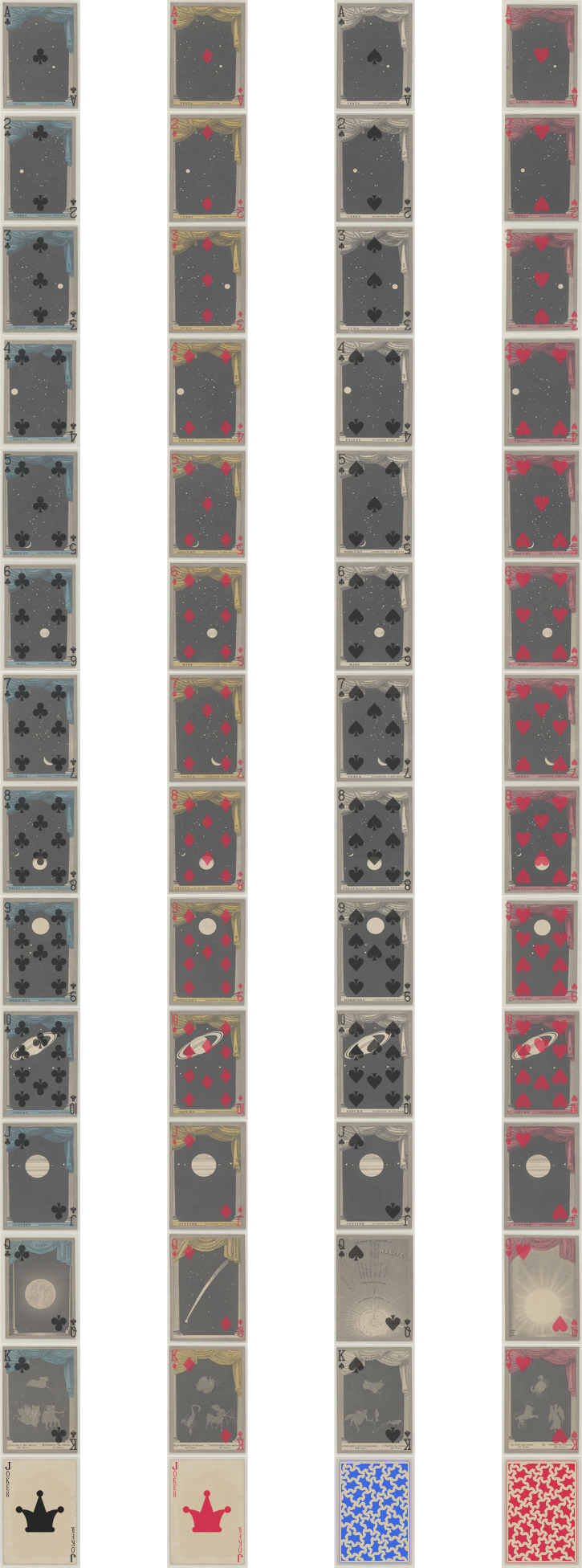

The Astronomia deck of playing cards was first printed in London in 1829 and reissued in 1831 by Sir Francis Graham Moon with illustrations by Henry Corbould.
For suits Astronomia uses color-coded seasons, and in this spritesheet the standard classic pips are superimposed over them for the purpose of using in games.
The .svg source file uploaded here is used directly with #fragments in the URL to display individual cards via the id of the VIEW element. It doubles as a self-navigating gallery and the navigation buttons will disappear from any card URL by removing "N" from the end of it, and the opacity increases for pips and ranks - handy for using directly in games.
Example game usage: SVG Klondike (This game is itself a Public Domain SVG file)
The Blue and Red card backs are a chiral aperiodic "spectre" monotile pattern of my own design.
From the Public Domain review: "Above the skyscape on each card is a table of cosmological data for particular extra-terrestrial objects: its distance from the sun, orbital eccentricity, and progression-per-hour are displayed on decorative curtain swags. Were you to fan them across a table, it would be like gazing through fifty-two windows onto outer space, framed by classical stone columns."
Neither Neptune nor Pluto were discovered yet so are not on any cards. The asteroid belt was also not yet figured out so four cards are dedicated to asteroids we thought were planets at the time. Earth is called Tellus after the Latin name for it and Uranus is called Herschel after its discoverer.
Update: I've included versions with German, Swiss and Latin (Italian, Spanish) pips.
 astronomiadeck.svg 3.5 Mb [11 download(s)] germanastronomiadeck.svg 3.5 Mb [4 download(s)] swissastronomiadeck.svg 3.5 Mb [4 download(s)] latinastronomiadeck.svg 3.6 Mb [4 download(s)]